How to Stay Ahead of Contract Complexity as Your Enterprise Grows
 Juan David Rodriguez, COO of Sotant
Most enterprises do not wake up one morning and decide to become hard to operate.
It happens gradually.
A few strategic customers ask for custom terms. Certain vendors negotiate special pricing. A new geography brings different service conditions. Key accounts get exceptions. Finance, operations, legal, and procurement all adapt. Everyone makes reasonable adjustments in the moment.
Then, over time, the business becomes harder to enforce than it looks from the outside.
This is what contract complexity actually feels like inside a growing enterprise. It is not just more contracts. It is more exceptions, more versions of commercial logic, more dependencies across teams, and more ways for execution to drift away from what was originally agreed.
That matters because poor contract management is not just a legal inconvenience. World Commerce & Contracting continues to report that organizations lose close to 9% of annual value on average through poor contract management.
For a growing enterprise, the real risk is not simply that contracts become harder to read. The risk is that they become harder to operationalize.
Why contract complexity gets dangerous as companies grow
In smaller organizations, contract complexity can often be absorbed informally.
A finance lead may know the major pricing rules by memory. An operator may know which customer has special service-level commitments. A founder may remember which commercial exceptions were approved and why.
That stops working as the company grows.
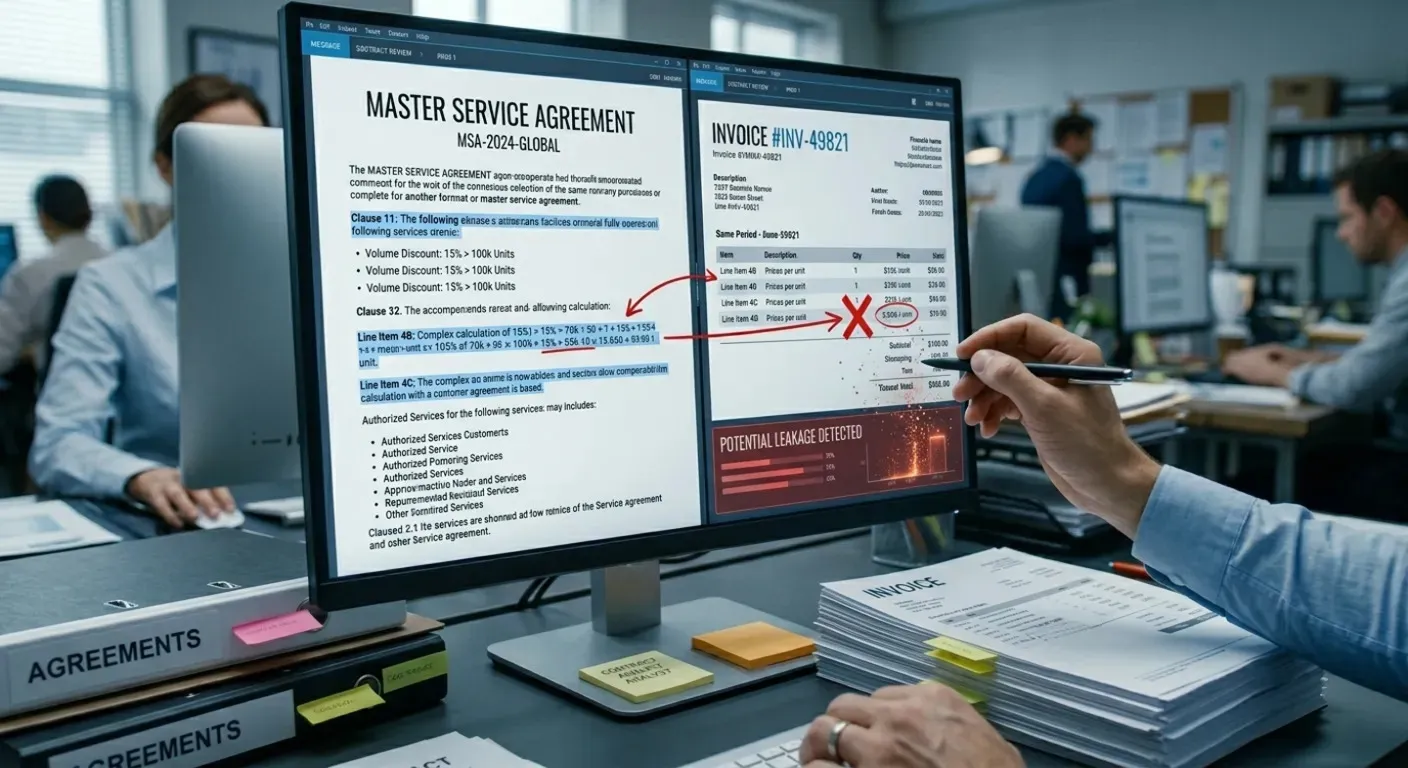
As scale increases, contracts start living across many places at once: signed PDFs, procurement workflows, email threads, CRM notes, finance rules, spreadsheets, amendments, and side conversations. The enterprise may think it has one commercial reality, but in practice it has multiple partial versions of it.
That is when complexity becomes dangerous.
The issue is not always that something is broken. It is that the business becomes increasingly dependent on people manually stitching the truth together.
Research and industry guidance continue to point to the same problem: post-signature failures often show up in invoicing errors, missed obligations, unrealized credits or discounts, and failure to bill for work that was contractually required and delivered.